Well, a lipid profile or a lipid panel is a type of blood test used to measure the abnormalities in lipids, or in other words, the concentration of cholesterol and fats in our blood.
“Approximately 45 percent of women over the age of 20 have a total cholesterol of 200 mg/dl and above, which is considered elevated, but a survey by the American Heart Association found that 76 percent of women say they don’t even know what their cholesterol values are,” says Erin Michos, M.D., associate director of preventive cardiology at the Ciccarone Center for the Prevention of Heart Disease.
Women’s cholesterol levels can fluctuate quite a bit after menopause and tend to increase with age, putting us at greater risk of heart disease and stroke.
Knowing your cholesterol numbers and how to control them is a big step toward staying healthy.
What is the lipid profile test used for?
The lipid profile test is important as it can identify dyslipidemia symptoms, and it can identify adults and children who are at risk of high blood cholesterol values and triglycerides.
This mostly occurs from the development of diabetes, high blood pressure, or heart disease.
The test also provides information on the levels of good cholesterol and bad cholesterol in our bodies.
What does a lipid profile test measure?
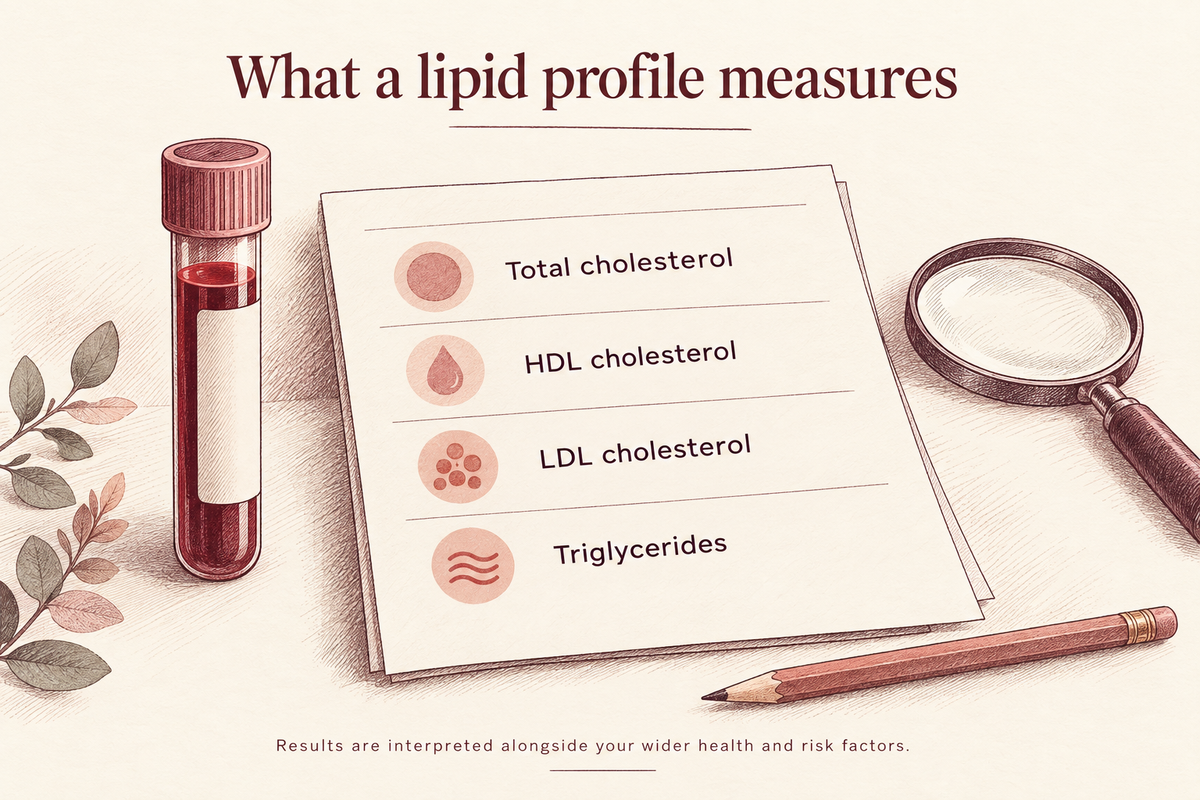
A standard lipid panel measures:
Total cholesterol. The sum of LDL plus HDL and very-low-density lipoprotein, or VLDL (particles that carry triglycerides to tissues and eventually become LDL).
High-density lipoprotein (HDL). High-density lipoprotein is also known as “good” cholesterol. These particles remove cholesterol from artery walls, thereby returning it to the liver for excretion.
Low-density lipoprotein (LDL). Low-density lipoprotein is also known as “bad” cholesterol. These particles deposit cholesterol in the cells of the artery wall, thereby creating artery-clogging plaque.
Triglycerides. Triglycerides are the most common form of fat in both food and the bloodstream. These particles store energy and deliver it to muscles.
A lipid profile measures different fats in the blood; results need to be considered alongside wider health and risk factors. · Elara Care · AI-assisted illustration
Is LDL good or bad?
LDL (low-density lipoprotein),also known as “bad” cholesterol, makes up most of your body’s cholesterol. High levels of LDL cholesterol can raise your risk for heart disease and stroke.
What are normal values for lipid profile?
For total cholesterol:
200 milligrams per deciliter (mg/dL) or less is normal.
201 to 240 mg/dL is borderline.
More than 240 mg/dL is high.
For HDL (“good cholesterol”),:
60 mg/dL or higher is good: it protects against heart disease.
40 to 59 mg/dL is OK.
Less than 40 mg/dL is low, raising your chance of heart disease.
For LDL (“bad cholesterol”):
Less than 100 mg/dL is ideal. 100 to 129 mg/dL can be good, depending on your health.
130 to 159 mg/dL is borderline high.
160 to 189 mg/dL is high. 190 mg/dL or more is very high.
For triglycerides:
150 mg/dL or less may be the goal your doctor recommends, though the American Heart Association recently suggested that a lower level is best for health.
151 to 200 mg/dL means you’re on your way to a higher risk for heart disease.
More than 200 mg/dL means you have a higher risk of heart disease.
Image awaiting migration
What is a good LDL HDL ratio?
According to the American Heart Association (AHA), you should aim to keep your ratio below 5, with the ideal cholesterol ratio being 3.5.
What is a good LDL level for a woman?
Research shows, for a woman, LDL cholesterol level should be less than 70 mg/dl, HDL cholesterol level ideally should be close to 50 mg/dl, Triglycerides should be less than 150 mg/dl, and total cholesterol levels well below 200 mg/dl are best.
What happens if the LDL cholesterol is high?
If you have too much LDL cholesterol, it can turn into a hard, waxy substance in your arteries, called plaque.
This causes your arteries to become narrow and less flexible. High cholesterol is one of the biggest risk factors for cardiovascular conditions such as heart disease and stroke.
Image awaiting migration
What foods increase LDL
While certain cholesterol-rich foods are highly nutritious and beneficial to your health, others can be harmful.
Some of them are fried food, fast food, processed meats, and desserts.
What are the symptoms of high cholesterol?
High cholesterol doesn’t exactly have any symptoms, in most cases, it just causes emergency events such as a heart attack or stroke.
These events do not usually occur until the formation of plaque in your arteries. Hence it is important to do a lipid test to check your cholesterol levels.
You are also recommended to check your cholesterol levels more frequently if you have a family history of high cholesterol, are overweight, have high blood pressure, or smoke.
What reduces cholesterol quickly?
A few dietary changes can reduce your cholesterol and improve your heart health:
Reduce saturated fats Saturated fats are mostly found in red meat and full-fat dairy products which can increase your LDL level.
Avoid trans fats Trans fats are mostly found in margarine and store-bought cookies, crackers, and cakes. They raise our overall cholesterol level
Eat foods rich in omega-3 fatty acids Foods with omega-3 fatty acids include salmon, mackerel, herring, walnuts, and flaxseeds. They do not affect LDL cholesterol levels but are known to have other heart-healthy benefits, including reducing blood pressure.
Increase soluble fiber is found in such foods as oatmeal, kidney beans, Brussels sprouts, apples, and pears. They can reduce the absorption of cholesterol into your bloodstream.
Add whey protein Whey protein is found in dairy products and may account for many of the health benefits attributed to dairy. Studies have shown that whey protein given as a supplement lowers both LDL cholesterol and total cholesterol as well as blood pressure.
How Is a lipid profile test done?
The test is usually done in the morning in a fasted state, wherein a few milliliters of blood are taken from our veins. In some cases, the blood sample will be taken by pricking your fingertip.
The collected blood samples are then analyzed in a laboratory. The procedure only lasts for a few minutes and does not have any risks associated with it.
Image awaiting migration
How often should I get a lipid profile test?
Every adult is recommended to get a lipid test performed every five years.
If risk factors such as heart disease are present, then you are recommended to take the test more frequently.
Having a high level of low-density lipoprotein(LDL) is one of the major risk factors leading to a number of diseases and medical conditions.
How do I prepare for a lipid profile test?
The doctor recommends fasting before the test, which means that you cannot eat or drink anything except water for 9 to 12 hours before the test. you should also take a few other precautionary measures
Do Not eat high-fat foods the night before
Avoid drinking alcohol
Avoid strenuous exercise
avoid drinking beverages such as coffee and tea.
Sometimes you can undergo the test without fasting, mostly for those up to the age of 24. Make sure to follow your doctor’s instructions about it.
Is LDL affected by fasting?
An ideal test is believed to be done with fasting. This is because your low-density lipoproteins (LDL) may be affected by what you’ve recently eaten.
Your levels of triglycerides may also be affected by a recent meal. New guidelines, published in the Journal of the American College of Cardiology, say that people who aren’t taking statins may not need to fast before the lipid profile test.
Can I drink water before my lipid profile?
Yes, you are expected to avoid food and liquids other than water for about 9 to 12 hours before the lipid profile test.
What is a lipid profile test price?
A standard lipid test as per London doctor’s clinical guidelines costs just £28.80.
The prices may increase as per the requirement of in-depth studies to find the LDL and HDL levels.
Founder of Elara Care and O.A. Dip. Certified Women's Health Practitioner, Jas is working to create better solutions for women since 2018, sharing her struggles and experiences with female health